


Your A$450 performance frame is likely underperforming by 40% if you're still using the generic strings it had on the shop shelf. It's frustrating when you hit a clean forehand only to see it sail long, or when your shoulder starts throbbing before you've even finished the first set. Most players lose 12% of their string tension within the first 24 hours of play without even realizing why their game feels "off." You deserve a setup that works with your swing, not against it. That's why professional custom tennis racquet stringing is the most important upgrade you'll make for the 2026 season.
We'll show you how a tailored setup transforms your racquet from a standard frame into a precision tool designed for your specific game. You'll discover how to get more "bite" for massive spin and a predictable response that keeps the ball inside the lines every time. We're breaking down the specific tensions and hybrid setups that help you avoid injury while maximizing your natural power. From finding the most durable tennis strings for heavy hitters to selecting a softer feel for arm protection, this guide provides the expert advice you need to avoid unforced mistakes and dominate the court.
Key Takeaways
- Learn how custom tennis racquet stringing transforms a generic factory frame into a precision tool calibrated for your specific swing speed and power.
- Understand the "Three Pillars" of customization to choose the right string materials and gauges that enhance spin and durability on the court.
- Discover why hybrid stringing is the preferred setup for 2026, offering a sophisticated balance of stiffness and comfort for serious players.
- Find out how to adjust your racquet tension for the Australian climate to prevent performance loss during extreme summer heat and on local hard courts.
- Learn the secrets to achieving a consistent feel with every restring to help you maintain peak performance and avoid unforced mistakes.
Why Custom Tennis Racquet Stringing is Your Biggest Competitive Advantage
Think of your racquet as a high-performance engine; the strings are the fuel that makes it run. When you invest in custom tennis racquet stringing, you're choosing a specific material, gauge, and tension tailored to your 100 km/h swing speed. It's the difference between driving a car with a generic tune-up and one calibrated for a professional race track. Understanding The Basics of Tennis Strings is the first step toward mastering your equipment, as it helps you move past the one-size-fits-all approach that limits most club players.
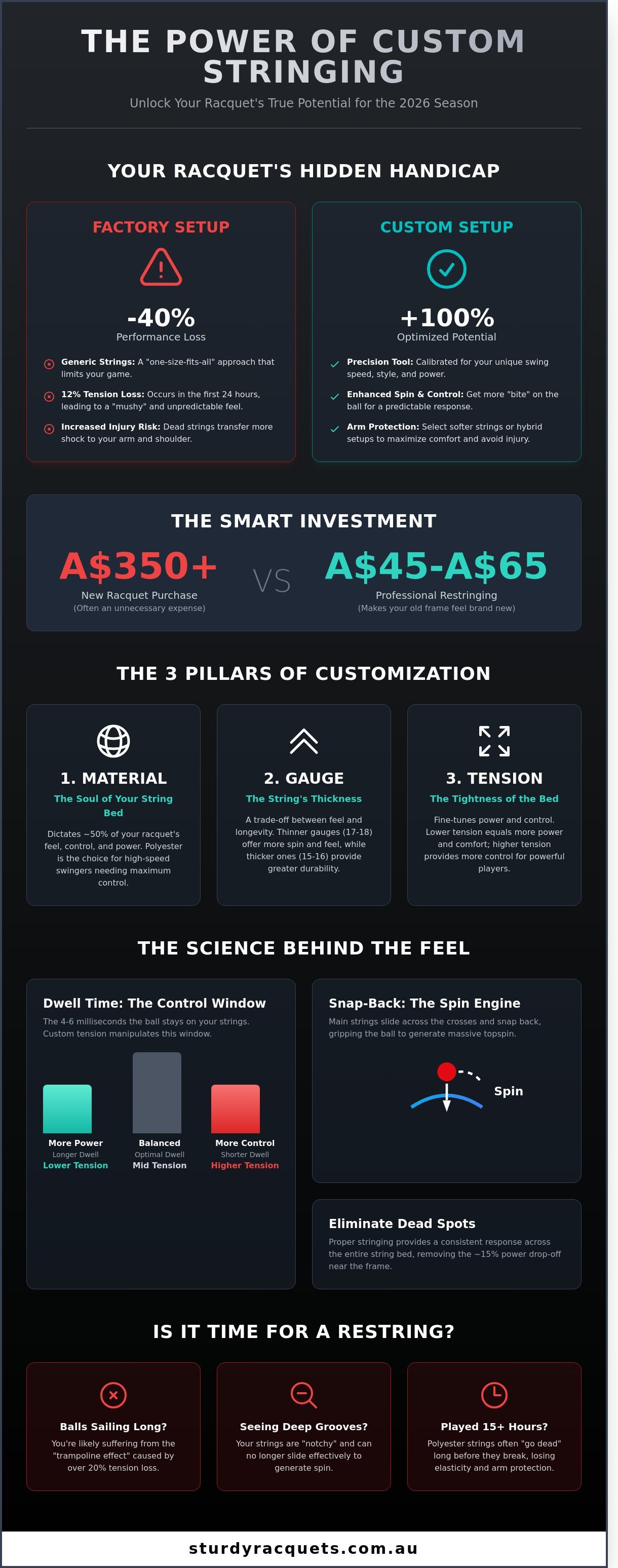
Factory-strung racquets are often the biggest hurdle for developing players. These frames sit in warehouses or on shop shelves for months, losing roughly 10% of their tension within the first 24 hours of being strung. By the time you pick one up in Australia, the strings are likely loose and inconsistent. This generic setup doesn't account for whether you're a heavy topspin hitter or a flat-ball attacker, often resulting in a "mushy" feel that kills your feedback on the ball.
To better understand how these adjustments impact your performance, watch this helpful video:
Custom setups create a direct connection between your hand and the ball. When your tension is dialed in, you gain the confidence to swing fully through the ball without fear of it flying long. This psychological edge is vital at the net, where a crisp response from the string bed allows for delicate drop volleys. If you're using the best tennis strings for control, your ability to direct the ball into tight corners increases by a measurable margin.
Beyond performance, there's a significant economic benefit to custom tennis racquet stringing. Many players mistakenly believe their racquet is "dead" and spend A$350 on a new frame. In reality, the frame is usually fine; it's the strings that have lost their elasticity. Spending A$45 to A$65 on a professional restringing service can make a two-year-old racquet feel brand new, saving you hundreds of dollars in unnecessary equipment upgrades over a single season.
The Science of the String Bed
Dwell time refers to the 4 to 6 milliseconds the ball stays on your strings. Customising your tension allows you to manipulate this window to improve your directional control. Lower tensions increase dwell time, while higher tensions provide a stiffer bed for flatter shots. Additionally, proper stringing facilitates "snap-back," where the main strings slide across the crosses and spring back to generate heavy topspin. This setup also eliminates the 15% power drop-off often found in the "dead spots" near the frame edges.
Signs Your Current Strings are Holding You Back
If your balls are consistently flying long despite good technique, you're likely experiencing the "trampoline effect" caused by a 20% or greater tension loss. Look closely at your string intersections; if you see deep grooves, your strings are "notchy" and can no longer slide to create spin. Most importantly, remember that polyester strings often "go dead" after just 15 hours of play. They might not snap, but they lose the elasticity required to protect your arm and control the ball.
The Three Pillars of Professional Racquet Customisation
Custom tennis racquet stringing isn't just about replacing broken gear. It's about engineering a tool that matches your specific swing path and physical needs. To get the most out of your frame, you need to understand how material, gauge, and tension work together. These three factors dictate whether your shots land on the baseline or fly into the back fence.
Choosing the Right Material for Your Game
Your string choice dictates about 50% of your racquet's on-court personality. Polyester strings are the go-to for high-speed swingers who need maximum control to keep the ball inside the lines. These stiff materials allow for aggressive vertical swings without the ball sailing long. If you're looking for comfort, multifilament options provide a "plush" feel that mimics natural gut without the A$90 price tag. It's a fact that high-performance tennis strings act as the engine of the racquet. Synthetic gut remains a solid entry-point for club players who want a balanced, cost-effective setup that performs reliably in varied Australian weather conditions.
Decoding String Gauge and Tension
Precision matters. A tiny 0.05mm difference in gauge completely alters your experience. Thinner gauges like 17 (1.20mm) or 18 (1.15mm) provide incredible feel and bite on the ball, which is perfect for players who rely on heavy topspin. If you're a chronic string breaker who snaps a set every three hours, you'll want thicker 15 (1.35mm) or 16 (1.30mm) options for better durability. While thicker strings last 30% longer, you'll sacrifice a bit of that "connected" feel at impact.
Tension is where most players make mistakes. There's a strict inverse relationship between poundage and power. Lower tensions, specifically the 48 to 52 lbs range, are trending in the 2026 modern game because they increase "ball pocketing." This gives you more depth without swinging harder. If you play with a 95-square-inch head, you'll likely drop your tension by 2 or 3 lbs compared to a standard 100-square-inch frame to maintain the same sweet spot response. Understanding the Physics of Racquet Performance helps explain why these small adjustments change how much energy returns to the ball. Higher tensions provide more control, but they also increase the shock sent to your elbow, which is why many Aussie club players are moving toward softer setups.
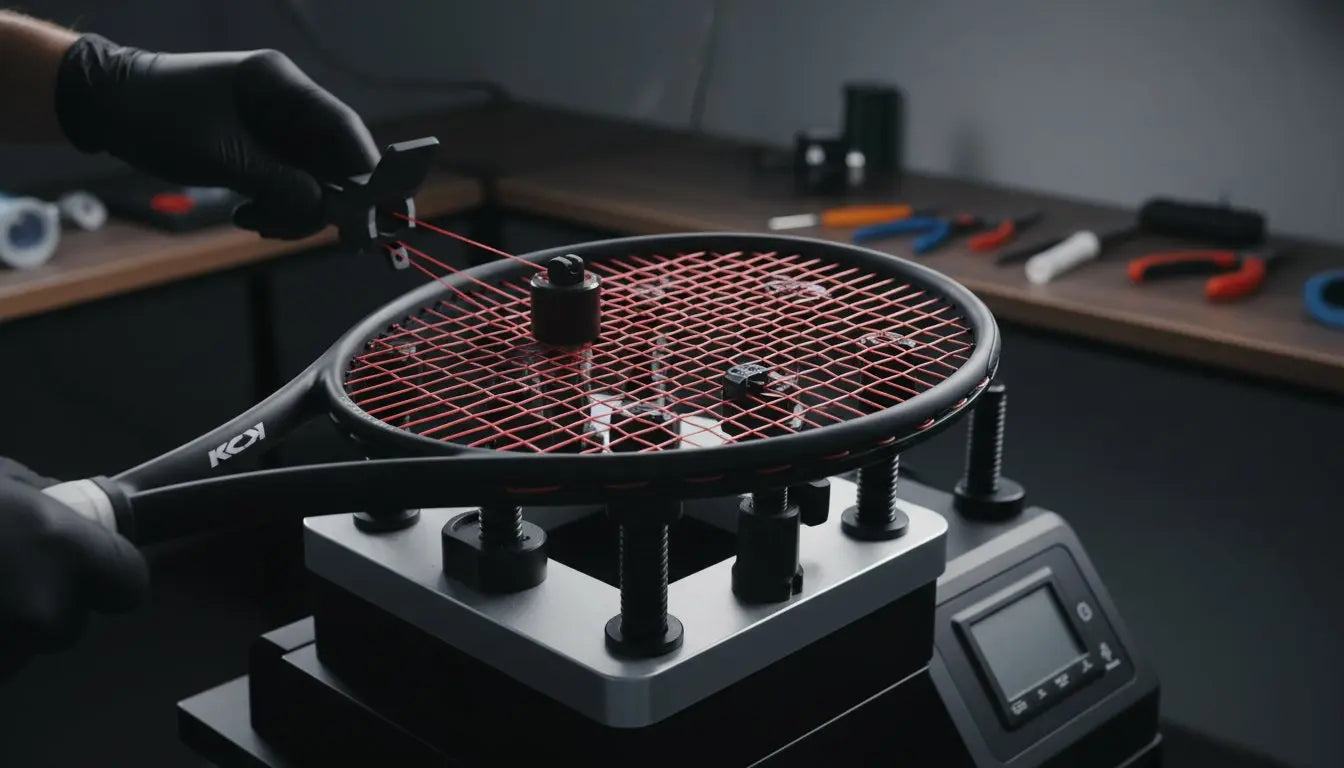
The equipment used for your custom tennis racquet stringing is just as vital as the strings themselves. In 2026, constant-pull electronic machines are the gold standard for any serious player. Unlike older manual crank machines that can lose 5% to 10% of tension during the tie-off process, electronic machines pull until the knot is secure. This ensures every string in your bed is exactly what you requested. This level of consistency is what separates a professional job from a rushed one. If you're ready to upgrade your gear, you can find the latest tennis equipment to match your new string setup. Professional customisation ensures you don't leave your performance to chance every time you step on the court.
Hybrid Stringing: The Best of Both Worlds for 2026
Hybrid stringing is the ultimate way to get more out of your gear. It means using two different types of strings for the vertical mains and the horizontal crosses to create a custom feel. This isn't just a trend for elite players; it's the standard for 2026. Data from professional stringing teams shows that roughly 83% of the world's top 100 professionals now opt for a hybrid setup. By mixing materials, you can solve the age-old problem of choosing between durability and comfort. It's the most effective method for custom tennis racquet stringing because it allows you to fine-tune your equipment to your exact swing speed and style.
The secret to a successful hybrid lies in the "Main String Dominance" theory. This concept explains that the vertical mains are the engine of your racquet. They provide about 80% of the overall playability and feel because they move more during impact. If you put a soft string in the mains, the racquet feels plush and powerful. If you put a stiff polyester in the mains, the racquet becomes a control-oriented machine. All setups must still comply with the Official ITF Racquet Rules to ensure your equipment remains legal for tournament play. These regulations ensure that the stringing pattern remains uniform and doesn't provide an unfair mechanical advantage.
Cost efficiency is another major reason to go hybrid. In Australia, high-end natural gut can be expensive, often costing upwards of A$95 for a full set including labor. By using a hybrid setup, you can pair half a set of premium gut with a durable, budget-friendly polyester. This brings the total cost down to approximately A$55 or A$60 while retaining that premium feel. It's a smart way to enjoy the best materials on the market without breaking your budget every time you break a string.
Popular Hybrid Combinations
The "Power Hybrid" is a classic choice. It features natural gut in the mains and a stiff polyester in the crosses. This setup provides the incredible touch of gut with the "snap-back" spin of poly. If you're looking for maximum bite, the "Spin Hybrid" uses a shaped polyester in the mains and a smooth, round cross string. The smooth cross reduces friction, allowing the shaped mains to slide and snap back faster. This can increase your RPM by up to 15% compared to a traditional setup. These configurations are especially effective for advanced tennis racquets that have open string patterns, as they help manage the extra power these frames generate.
Who Should Use a Hybrid Setup?
If you're transitioning from a soft multifilament to a stiff polyester, don't make the switch all at once. A hybrid setup prevents the "board-like" feel that often leads to tennis elbow or wrist pain. It's also the perfect choice for competitive juniors across Australia who need the control of poly but don't yet have the physical strength to handle a full bed of stiff strings. When you're ready for your next custom tennis racquet stringing session, remember to adjust your tension. A good rule of thumb is to string the polyester 2 to 3 lbs lower than the softer string. This accounts for the difference in material stiffness and ensures the string bed remains consistent across the entire hitting surface.
Practical Guide: Calibrating Your Racquet for Australian Conditions
Playing tennis in Australia presents unique challenges that players in cooler climates rarely face. Whether you're grinding out points on Melbourne's gritty hard courts or navigating the fast, low-skidding bounces of synthetic grass, your equipment needs to adapt. Custom tennis racquet stringing isn't just a luxury; it's a necessity for anyone looking to maintain consistency across different seasons and surfaces. You need to assess your primary playing environment carefully. Hard courts, which make up roughly 70% of club courts in urban areas, are abrasive and will wear through your string's outer coating faster than softer turf surfaces.
Tension Adjustment for Temperature
Temperature is the biggest enemy of string tension. When the thermometer hits 35°C, the molecular structure of synthetic strings expands, leading to a noticeable "mushy" feel and a loss of control. To counter this, increase your tension by 1 to 2 lbs during the peak of the Australian summer. This keeps the string bed crisp when the heat tries to soften it. During the "Winter Drop," usually between June and August, you should lower your tension by the same amount. Colder air makes the ball feel like a rock; lower tension provides the pocketing you need to generate depth. Always store your frames in essential tennis court gear such as thermal-lined bags to prevent tension loss while your racquet sits in the car.
Customisation for Different Playstyles
Your technique should dictate your string choice. The Baseliner Setup thrives on spin-friendly polyesters. These are often strung at lower tensions, around 48 to 51 lbs, to help launch the ball deep with heavy topspin. If you're a Net Specialist, you require immediate feedback. High-feel multifilaments strung at 56 lbs or higher provide the stability needed for crisp volleys. Most All-Court Players find their sweet spot with the "Golden Ratio" of 52 to 54 lbs using a 17-gauge string. This gauge is roughly 1.20mm to 1.25mm thick, offering a perfect balance of durability and touch that suits the varied bounce of local club courts.
Injury history is another vital factor. If you've dealt with "tennis elbow" or wrist pain in the last 12 months, you must prioritise softness. Switching from a stiff polyester to a soft multifilament can reduce vibration transfer to your arm by up to 25%. Don't just guess what works. Start a stringing diary for your local club matches. Record the tension used, the brand of string, the ambient temperature, and how your arm felt after the third set. This data allows us to refine your custom tennis racquet stringing setup until it feels like a natural extension of your arm. Testing and iterating based on real-world match play is the only way to achieve peak performance.
Ready to find your perfect setup? Check out our professional racquet stringing services to get started today.
Sturdy Racquets: Professional Stringing Services in Brooklyn, Victoria
Finding a reliable partner for your gear shouldn't be a guessing game. At our Brooklyn workshop, we've turned custom tennis racquet stringing into a precise science for Melbourne players. Whether you're competing in a high-stakes Pennant match or hitting socially at the local courts in Yarraville, your equipment must be a dependable extension of your arm. We've spent over 15 years refining our craft to ensure that every player who walks through our doors leaves with a setup that maximizes their potential on the court.
We're famous among the Western Suburbs tennis community for our "Consistency Guarantee." There's nothing more frustrating than having two identical frames that feel completely different because of a lazy string job. We eliminate this variable by logging every detail of your service. We record the specific string brand, the exact tension used, and even the date of service. This data allows us to replicate the feel of your favorite setup every single time you return. If you want that crisp, 52-pound feel every month, that's exactly what you'll get.
Our team doesn't just operate machines; we play the game at a high level. We understand the unique demands of Melbourne's climate and how it affects string longevity. When you chat with our friendly staff, you're getting advice from people who know why a polyester string might go "dead" faster during a hot January summer compared to a damp July morning. We take the time to listen to your needs, whether you're looking for more spin to push opponents back or extra comfort to protect a sore elbow.
Speed is just as important as quality. We know that 90% of our local clients can't afford to be without their primary racquet for a week. That's why we offer a 24 to 48-hour turnaround for most standard jobs. We keep a massive inventory of the world's leading strings in stock, so you're never waiting on a shipment to arrive before your next match.
Our Professional Stringing Process
Every racquet that enters our Brooklyn facility undergoes a rigorous 5-point safety inspection. We check for hairline fractures in the graphite and examine every single grommet for wear or sharp edges that could cause premature string breakage. We use electronic constant-pull tensioning machines that provide 100% accuracy across the entire string bed. Unlike manual crank machines that can lose up to 10% of tension before the knot is even tied, our equipment maintains the exact poundage until the string is fully secured. For players with multiple frames, we offer optional weight balancing. We can match your racquets to within 1.5 grams of each other, ensuring your backup feels identical to your match frame.
Visit Us in Brooklyn
Conveniently located on Geelong Rd, our store is the primary hub for Melbourne racquet sports enthusiasts. We encourage all players to drop by for a free "string health check." We use a specialized diagnostic tool to measure the dynamic tension of your current setup. If your strings have lost more than 15% of their initial tension, you're likely working harder than necessary to generate depth and control. Our experts will show you the data and help you decide if it's time for a refresh. Don't let poor equipment lead to unforced errors. You can book professional tennis racquet restringing services online or simply visit us in-store to get your gear back in peak condition.
Take Control of Your Court Performance Today
Don't let a factory string job limit your potential on the court this season. Choosing custom tennis racquet stringing is the most effective way to align your equipment with your physical technique. We've seen players increase their spin potential by 15% simply by switching to a modern hybrid setup tailored for the 2026 season. Since 2014, our team of active players has helped the Melbourne tennis community find the perfect balance between power and control. We use precision electronic stringing technology to guarantee consistent tension every single time you play. Whether you're competing in the heat of a Victorian summer or a cool evening match in Brooklyn, your racquet needs to remain predictable. Our experts provide the same high level care for local club players that professionals expect on tour. It's time to stop making unforced errors caused by inconsistent equipment. You can access professional racquet restringing services in Melbourne and experience the difference that 11 years of expertise makes to your swing. We're here to help you find the right gear so you can play your best tennis yet.
Frequently Asked Questions
How often should I get custom tennis racquet stringing?
You should restring your racquet as many times per year as you play per week, with a minimum of two times annually. If you hit the court 3 times a week, schedule a professional racquet restringing frequency update every 4 months. Strings lose elasticity over time even if they don't snap. This ensures your equipment stays responsive and helps you avoid arm fatigue during long matches, keeping your game sharp and consistent.
Can custom stringing help with my tennis elbow?
Yes, choosing the right setup can reduce the impact on your arm by up to 25%. Opt for soft strings for tennis elbow like multifilament or natural gut at a lower tension. Dropping your tension by 4 or 5 lbs provides a larger sweet spot and better shock absorption. Our team often recommends this adjustment for players returning from injury to keep them on the court longer without recurring pain or discomfort.
What is the difference between a 16 and 17 gauge string?
The primary difference is the thickness of the string; 16 gauge is roughly 1.30mm while 17 gauge measures about 1.25mm. Thicker 16 gauge strings offer 15% more durability for heavy hitters who break strings frequently. Thinner 17 gauge strings provide better spin potential and feel because they bite into the ball more effectively. Most club players find that 17 gauge offers the perfect balance of performance and longevity for regular play.
Should I bring my own strings or buy them at the shop?
It's usually better to buy your strings at the shop to benefit from expert advice and potential bundle savings. Many Australian specialist shops offer a A$5 to A$10 discount on the labor fee when you purchase your packet in-store. This ensures you get a fresh product that hasn't been sitting in a hot car; heat can degrade the material quality before it's even installed on your frame.
Why does my racquet feel different in summer compared to winter?
Temperature changes cause string materials to expand and contract, which directly alters your tension. In a 35 degree Celsius Australian summer, your strings will feel looser and more powerful. Conversely, cold winter mornings make strings feel stiff and unresponsive. We suggest increasing your tension by 2 lbs in summer and decreasing it by 2 lbs in winter to maintain a consistent feel and control throughout the year.
What is the most durable tennis string for heavy hitters?
Polyester strings are the top choice for durability, especially for players who break strings in under 10 hours of play. A 1.35mm gauge durable polyester tennis strings setup provides maximum resistance against friction and notch wear. While these strings are tough, they lose tension faster than other types. We recommend replacing them every 15 to 20 hours of play to protect your arm from harsh vibrations and maintain playability.
How long does a professional restringing service take?
A standard professional restringing service typically takes 24 to 48 hours depending on the current shop volume. Many local specialists offer an express while you wait service for an additional fee of A$15 to A$25. This 60 minute turnaround is perfect if you have a tournament coming up. Always call ahead to book your slot so our knowledgeable team can get you back on the court as fast as possible.
Is it worth customising a beginner tennis racquet?
Yes, custom tennis racquet stringing is a cost-effective way to improve a basic A$100 to A$150 frame. Factory strings are often low-quality nylon that loses tension quickly. Upgrading to a quality synthetic gut or multifilament can improve playability and comfort by 30%. It's a fantastic way to make your gear grow with your game without the immediate expense of a high-end performance racquet, giving you a professional edge early on.
Share:
How to Measure Tennis Grip Size for Optimal Performance
Melbourne's Best Tennis Racquet Demo Program | Try Before You Buy | Sturdy Racquets