


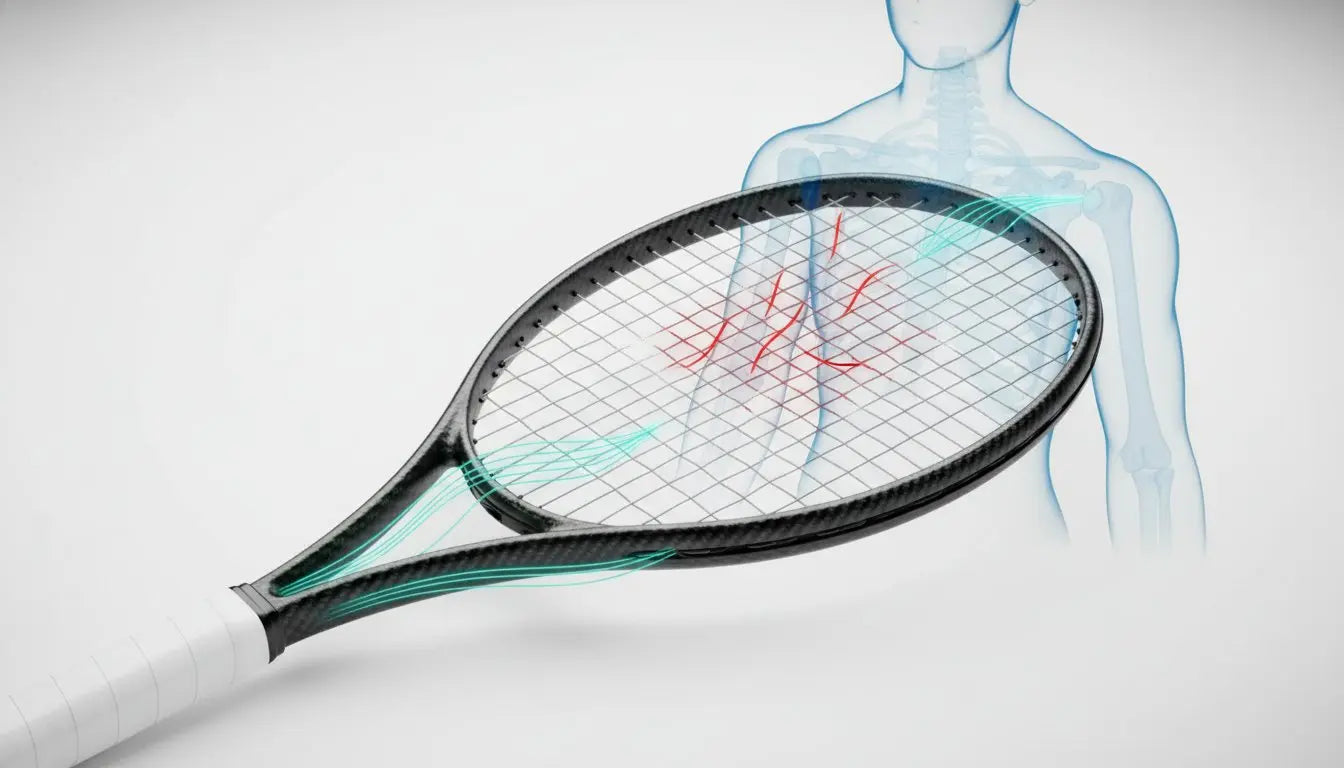
What if the very tool you use to dominate the baseline is secretly sabotaging your rotator cuff every time you swing? It's a common frustration to finish a match only to feel a deep ache the next morning or a sharp twinge during an overhead serve. You've likely found yourself asking, is my racquet causing my shoulder pain, or is it just a matter of poor technique? While your swing path matters, your gear often acts as a force multiplier that can either cushion your joints or drive impact directly into your shoulder.
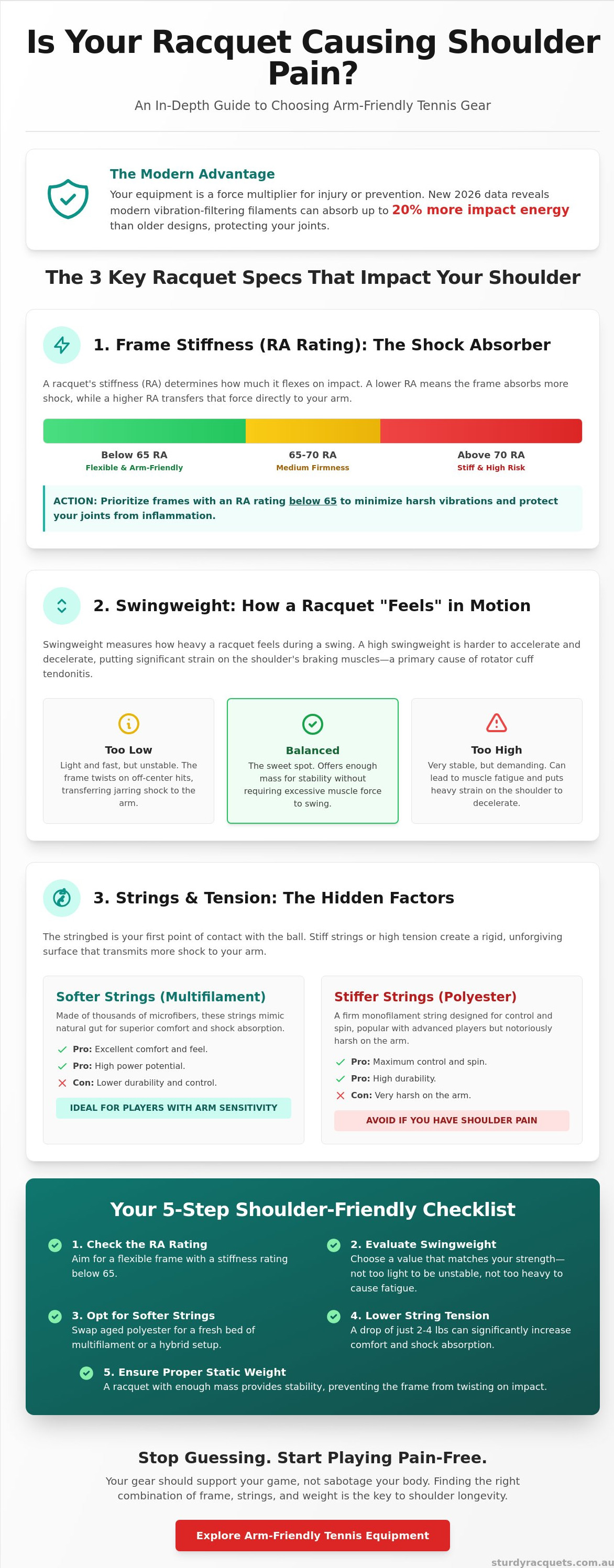
You shouldn't have to sacrifice power to stay healthy. Recent 2026 data shows that modern vibration-filtering filaments can now absorb up to 20% more impact energy than older designs, but only if you choose the right specs. In this guide, you'll discover how weight, stiffness, and strings influence your physical health. We will provide a checklist to evaluate your current setup and help you find arm-friendly tennis equipment that keeps you on the court pain-free. It's time to stop guessing and start playing with a setup that supports your game and your body.
Key Takeaways
- Identify whether your equipment acts as a force multiplier for injury and finally answer the question "is my racquet causing my shoulder pain" by analyzing technical specs.
- Learn why choosing a frame with an RA rating below 65 is critical for minimizing the harsh vibrations that lead to joint inflammation.
- Discover the impact of string material and why swapping aged polyester for softer multifilament strings can save your rotator cuff.
- Follow a simple 5-step checklist to balance your racquet's static weight and swingweight for a more comfortable, efficient stroke.
- Explore how professional equipment selection and customization can bridge the gap between generic gear and your specific physical needs.
Can a Tennis Racquet Actually Cause Shoulder Pain?
Many players wonder, is my racquet causing my shoulder pain? It's a valid question. Think of your frame as a force multiplier. If your technique is slightly off, a stiff or poorly balanced racquet amplifies that stress. It isn't just about how you swing; it's about what you're swinging. "Tennis shoulder" is rarely caused by one single factor. Instead, it's a combination of your equipment, your physical load, and your stroke mechanics.
To better understand how these forces impact your body, watch this helpful video:
You need to distinguish between "good" muscle soreness and "bad" joint pain. Soreness in the deltoids or latissimus dorsi usually means you've had a great workout. However, sharp, localized pain deep inside the shoulder joint is a red flag. This often stems from poor kinetic energy transfer. Ideally, the racquet should absorb the shock of the ball. When a racquet is too stiff or the strings are "dead," that energy bypasses the equipment and travels directly into your rotator cuff.
Common Shoulder Injuries in Racquet Sports
Rotator cuff tendonitis is the most frequent culprit, where repetitive overhead motions like serves create painful micro-tears. Subacromial bursitis is another common issue, often triggered by the high-frequency impact vibrations from modern frames. There's also the "heavy racquet" myth to consider. While a heavier frame can provide more stability, if the mass is too high for your current strength, it becomes a liability. Understanding how your racquet's weight and stiffness affect your shoulder is the first step toward prevention.
The Equipment-Body Connection
Your gear choice directly dictates the amount of shock your shoulder must manage. High-quality performance tennis racquets are designed to mitigate this, but even the best frame can't save you from off-center hits. When you miss the "sweet spot," the racquet twists, creating a torque that your shoulder must stabilize. Modern tech helps. For instance, 2026 frames feature vibration-filtering filaments that absorb up to 20% more impact energy than older models. Playing through pain with outdated or unsuitable gear often turns a minor tweak into a chronic condition.
The Three Racquet Specs That Impact Your Shoulder Health
If you are asking, is my racquet causing my shoulder pain, the answer usually lies in three technical specifications: stiffness, weight distribution, and swingweight. These specs determine how much force your body must absorb versus how much the gear handles for you. While manufacturers often push for stiffer frames to increase power, your shoulder might be paying the price for that extra ball speed. Understanding these metrics helps you move away from gear that punishes your joints.
Frame Stiffness (RA Rating) Explained
Stiffness is measured by an RA rating. A rating above 70 is considered very stiff, while anything below 65 is generally safer for your joints. In 2026, we see a shift toward lower RA frames that prioritize player health. For example, the Wilson Clash 100 v3 features a stiffness rating of 55 RA, which is the lowest among performance frames this year. A flexible frame acts like a shock absorber. It bends slightly on impact, dissipating energy before it reaches your rotator cuff. When browsing high-performance tennis racquets, prioritizing a lower RA can significantly reduce the jarring sensation on off-center hits.
Swingweight: The Secret to Shoulder Longevity
Swingweight is often misunderstood. A racquet can feel light when you pick it up but feel like a heavy weight once you start your service motion. This is swingweight. If this number is too high for your current strength, your shoulder has to work significantly harder to decelerate the racquet after contact. This repetitive braking action is a primary cause of rotator cuff tendonitis. Many tennis racquets for intermediate players offer a balanced swingweight. This helps you transition to more advanced play without overloading the joint. Finding that "Goldilocks" zone ensures you have enough mass to plow through the ball without taxing your muscles.
Balance point is the final piece of the puzzle. Head-heavy racquets might provide more power, but they also create more leverage against your shoulder joint. This extra torque forces the rotator cuff to stabilize a moving weight that is further away from your hand. Pairing a slightly head-light balance with modern vibration-filtering filaments can create a much safer playing experience. These filaments in 2026 frames can absorb up to 20% more impact energy than older designs. If you're unsure which spec is the culprit, you should consult with a racquet specialist to find a setup that fits your biomechanics.
Strings and Tension: The Hidden Factors in Shoulder Strain
You might have the perfect frame, but if your strings are outdated or too stiff, your shoulder is still at risk. Many players focus entirely on the racquet while ignoring the string bed, which is the only part of the gear that actually touches the ball. If you are still asking, is my racquet causing my shoulder pain, and your frame specs are already arm-friendly, the culprit is likely your strings. Think of strings as the suspension system of your racquet. When that suspension fails, your rotator cuff absorbs the impact.
Polyester strings are often the silent killer of shoulder health. While they offer incredible spin and control, they are naturally stiff and lose their elasticity quickly. A 2025 survey of club players revealed that 62% now prefer a softer feel for better ball pocketing, yet many still use dead polyester. Once polyester strings lose their tension, they stop stretching and begin to feel like a wooden board. At this stage, they transmit high-frequency vibrations directly to your bicep tendon and shoulder joint.
The Problem with Polyester Strings
The vibration frequency of stiff monofilament strings can be incredibly harsh. Unlike multifilaments, which are made of thousands of micro-fibers, polyester is a single solid strand. It doesn't cushion the ball; it fights it. For players struggling with lingering soreness, choosing arm-friendly tennis strings is just as important as the racquet itself. Switching to a multifilament or a high-quality synthetic gut can immediately reduce the load on your joints by allowing the string bed to deform and absorb energy during the hit. This shift in material prevents the sharp shock that leads to chronic inflammation.
Tension and Impact Force
Tension dictates how much work your body has to do to move the ball. High tension provides a crisp feel and more control, but it also increases the peak impact force on your shoulder. By dropping your tension, you create a trampoline effect that helps propel the ball with less physical effort from your swing. In 2026, the trend has shifted toward lower ranges, with most enthusiasts finding their ideal tension between 48 and 52 lbs. This lower range allows for better ball pocketing and a more forgiving response on off-center hits.
Don't wait for your strings to break before replacing them. Following the 20-hour rule is a great way to protect your health. If you play twice a week, you should look into professional racquet restringing every few months. Fresh strings provide the elasticity needed to keep shock away from your rotator cuff. If your strings feel mushy or you're working harder than usual to get depth, they've likely gone dead and are putting your shoulder at risk.
A 5-Step Checklist for a Shoulder-Friendly Setup
If you've been asking, is my racquet causing my shoulder pain, it's time to stop guessing and start auditing. You can systematically break down your setup to find the exact pressure points. While we've discussed how stiffness and strings play a role, a healthy shoulder requires every piece of the puzzle to fit. Use this 5-step checklist to evaluate your current gear:
- Verify Frame Flex: Ensure your frame's RA rating is below 65 to protect your rotator cuff from harsh feedback.
- Audit String Bed: Replace aged polyester with softer multifilament strings to improve shock absorption.
- Check Grip Size: A grip that is too small causes excessive squeezing, leading to tension in the shoulder.
- Optimize Balance: Switch to a head-light setup to reduce the leverage and torque on your joints.
- Evaluate Serve Form: Shift the power source from your arm to your legs to prevent overuse injuries.
Testing Your Equipment
Try the 'Shadow Swing' test. Swing your racquet in slow motion through your full service motion without a ball. If you feel a tugging sensation in your shoulder at the peak of your swing, the swingweight is likely too high for your current strength level. You should also perform a 'Vibration Test' during your next practice session. Pay close attention to the 'buzz' or tingling you feel in your hand on off-center hits. High-frequency vibration is a major contributor to joint inflammation. If you feel a sharp jar every time you hit slightly off-center, your racquet isn't doing its job. You can use how to choose a tennis racquet principles to audit your current bag and see if your gear actually matches your physical needs.
Technique Adjustments to Support Your Gear
Your equipment doesn't work in isolation. A shorter backswing can drastically reduce the stress on your shoulder by minimizing the time the joint spends in a vulnerable, loaded position. This change allows you to focus on timing rather than raw force. Don't forget your non-dominant arm; it's essential for balancing your torso and preventing the over-rotation that leads to injury. Your power should always come from the ground up. Leg drive is the engine of a healthy serve. Investing in high-quality tennis shoes provides the stability required to use your lower body effectively, which prevents your shoulder from overcompensating during high-intensity rallies.
Expert Racquet Customisation at Sturdy Racquets
Finding an answer to the question, is my racquet causing my shoulder pain, often requires looking beyond the factory specs. Most off-the-shelf racquets are designed for a "standard" player who doesn't exist. Your height, swing speed, and even the local Melbourne climate play a role in how gear performs. For example, playing on Australian hard courts in high heat increases ball speed and impact force. This puts extra strain on your joints compared to softer surfaces. Generic gear simply can't account for these environmental variables.
Personalised Equipment Matching
Our team takes a hands-on approach to help you find a setup that protects your body. We evaluate your swing style to determine if you need more mass for stability or a more flexible frame for shock absorption. One of the best ways to ensure a pain-free experience is to test frames in real-world conditions. We encourage players to explore our extensive range of tennis racquets for all playing levels. Demoing a racquet allows you to feel how the balance and stiffness impact your shoulder before you commit to a purchase.
The Role of Professional Stringing
Professional stringing is about more than just hitting a specific number on a machine. At our Brooklyn store, we use the Yonex Precision 9.0 stringing machine, which is the same high-end equipment trusted at major events like the Australian Open. Our experts focus on how string choice and tension work together to create a safer hitting zone. We can also help you fine-tune your setup with the right vibration dampening tennis accessories to further reduce joint stress. Standard turnaround for our restringing service is 24 to 48 hours, ensuring you don't miss much time on the court.
Joining a community that prioritises performance and health is the best way to stay in the game long-term. Whether you're a beginner or a seasoned club player, a custom setup bridges the gap between struggling with soreness and playing with total confidence. Visit us in Brooklyn for a full assessment of your current racquet. We'll help you dial in the perfect specs so you can focus on your game without worrying about your shoulder. Getting your equipment right is an investment in your future on the court.
Take Control of Your Shoulder Health Today
Your equipment is far more than just a tool; it's a complex system that either protects your body or puts it at risk. By auditing your RA ratings and choosing softer string materials, you can significantly reduce the vibration reaching your joints. If you've been asking, is my racquet causing my shoulder pain, the answer is often found within the technical specs of your current gear. Small adjustments, such as dropping your tension or switching to a head-light balance, can make a massive difference in your long-term comfort on the court.
Don't let gear-related soreness keep you on the sidelines. Our team provides expert advice from passionate racquet specialists and a wide range of equipment for all levels and physical needs. We offer professional in-store stringing services to ensure your setup is perfectly tuned for your biomechanics. You should visit our Brooklyn store for an expert racquet and string assessment to find a setup that works with your body. We look forward to helping you play your best tennis without the ache.
Frequently Asked Questions
Will a lighter tennis racquet help my shoulder pain?
Not necessarily. While a lighter racquet is easier to swing, it often lacks the mass required to absorb ball impact. This means more vibration is transmitted directly to your arm. A mid-weight racquet with a head-light balance usually provides better stability and shock absorption for a sensitive shoulder than an ultra-light frame.
What is the best racquet stiffness (RA) for someone with a rotator cuff injury?
You should look for a racquet with an RA rating below 65. Stiffer frames don't flex enough on impact, which sends the shock directly into your joints. Frames like the Wilson Clash 100 v3, which has a 55 RA, are specifically engineered to flex and protect the rotator cuff during high-velocity swings.
How do I know if my shoulder pain is caused by my racquet or my technique?
Racquet-induced pain often presents as a sharp twinge specifically during off-center hits or heavy serves. If you're asking, is my racquet causing my shoulder pain, check if the discomfort only appears when using a specific frame or string setup. Technique issues usually involve generalized muscle fatigue that persists regardless of the gear you use.
Can the wrong grip size cause shoulder problems?
Yes, a grip that's too small or too large forces you to squeeze the handle too tightly to maintain control. This "death grip" creates tension that travels up your forearm and into your shoulder assembly. A properly sized grip allows for a relaxed hand, which helps keep your shoulder muscles loose and fluid during the service motion.
Which strings are the most 'arm-friendly' for sensitive shoulders?
Multifilament and natural gut strings are the gold standard for shoulder health. These materials consist of thousands of micro-fibers that stretch significantly more than polyester. This elasticity cushions the ball and prevents high-frequency vibrations from traveling through the frame and into your rotator cuff.
Does a head-heavy racquet put more strain on the shoulder than a head-light one?
Yes, head-heavy racquets create significantly more leverage against your shoulder joint. Because the weight is concentrated further from your hand, your rotator cuff must work much harder to stabilize and decelerate the racquet. A head-light balance keeps the mass closer to your body, reducing torque and joint stress.
Should I stop playing tennis until my shoulder pain is completely gone?
You should stop playing if the pain is sharp, localized, or worsens during activity. Continuing to play with the wrong equipment can turn a minor tweak into a chronic labral tear or severe tendonitis. Once a medical professional clears you, ensure you've updated to a shoulder-safe racquet and string setup before returning to the court.
How often should I restring my racquet to prevent injury?
You should restring your racquet every 20 hours of play or at least every three months. Even if they don't snap, strings lose their elasticity over time and become "dead." These stiff strings stop absorbing shock and begin acting like a solid board, sending every ounce of impact force directly into your shoulder.
Share:
How to Prevent Tennis Elbow with the Right Gear: The 2026 Player’s Guide
Pickleball Shoes vs Tennis Shoes Difference: A 2026 Court Guide